Sending a strong message to Denmark, India on Friday said Danish high court's refusal to allow extradition of Purulia arms drop case accused Kim Davy has "grave and far-reaching" implications and can only serve as an encouragement to terrorists and criminals.
The external affairs ministry while expressing its great disappointment over the court verdict also said India's demand that Davy be handed over by Denmark stands and he must stand trial in this country for his actions.
Noting that Danish government had decided on April 9, 2010, to extradite Kim Davy to India, he said "but the Danish authorities failed to successfully defend their decision in the Danish courts and it is regrettable that they have decided not to appeal the high court judgement in the Supreme Court."
"Completely rejecting" the grounds cited by the Danish court as the basis for its decision, he said "Our demand for the extradition of Kim Davy to India stands. He must face the law in India for his actions."
Government sources meanwhile emphasised that Danish authorities must ensure that "terrorists and gunrunners do not find easy safe haven" in their country and made it clear that the relations and interactions between the two countries will always be based on the strict principle of reciprocity.
"Conditionalities insisted upon by the Danes will apply in respect of any request received by us from them in the similar manner," they said.
More at The Times of India

Something is rotten in Denmark. This is a blog about my thoughts, feelings, pictures about Denmark. I was there for one and a half year.I was impressed and disappointed at the same time. Denmark looks very well from outside but very bad from inside.

Denmark has stolen children from their foreigner parents
Friday, July 08, 2011

Tuesday, July 05, 2011
Schengen state Denmark beefs up border controls
Denmark, part of the Schengen border-free zone, has deployed extra customs officers on its frontiers in a move causing concern among EU neighbours.
Thirty additional officers were being posted on the Danish land border with Germany and 20 others on the country's sea borders.
Denmark's government is under pressure to curb illegal immigration.
The centre-right coalition moved to introduce the additional customs agents after calls from its populist ally, the right-wing Danish People's Party (DPP), and the legislation cleared parliament on Friday.
But many have questioned the legality of the Danish move under the 1995 Schengen Agreement, which abolished internal borders, enabling passport-free movement inside much of western Europe.
 A Dutch motorist appeared slightly alarmed after being stopped by customs officers after she entered Denmark from Germany at Froslev on Tuesday morning, the online edition of Jyllands-Posten reports.
As the first motorist to be checked, she was asked to pull over 20m inside the border, and found herself being questioned by several customs officers as some 50 media people crowded around her car, the paper says.
The Danish reinforcements come on top of a force of about 160, which will grow to 260 by the end of this year, according to Reuters news agency.
Denmark's ruling coalition of liberals and conservatives relies on the right-wing DPP's support to pass legislation in parliament.
More: BBC
Thirty additional officers were being posted on the Danish land border with Germany and 20 others on the country's sea borders.
Denmark's government is under pressure to curb illegal immigration.
The centre-right coalition moved to introduce the additional customs agents after calls from its populist ally, the right-wing Danish People's Party (DPP), and the legislation cleared parliament on Friday.
But many have questioned the legality of the Danish move under the 1995 Schengen Agreement, which abolished internal borders, enabling passport-free movement inside much of western Europe.
A Dutch motorist appeared slightly alarmed after being stopped by customs officers after she entered Denmark from Germany at Froslev on Tuesday morning, the online edition of Jyllands-Posten reports.As the first motorist to be checked, she was asked to pull over 20m inside the border, and found herself being questioned by several customs officers as some 50 media people crowded around her car, the paper says.
The Danish reinforcements come on top of a force of about 160, which will grow to 260 by the end of this year, according to Reuters news agency.
Denmark's ruling coalition of liberals and conservatives relies on the right-wing DPP's support to pass legislation in parliament.
More: BBC
Monday, July 04, 2011
Sunday, July 03, 2011
Thursday, June 30, 2011
Denmark – Amnesty International Report 2011
Denmark
Head of state:Queen Margrethe II
Head of government:Lars Løkke Rasmussen
Death penalty: abolitionist for all crimes
Population: 5.5 million
Life expectancy:78.7 years
Under-5 mortality (m/f):6/6 per 1,000
Head of state:Queen Margrethe II
Head of government:Lars Løkke Rasmussen
Death penalty: abolitionist for all crimes
Population: 5.5 million
Life expectancy:78.7 years
Under-5 mortality (m/f):6/6 per 1,000
Counter-terrorism legislation continued to give rise to concern. Forced returns contrary to international guidelines, including to Iraq, continued. Women were not adequately protected against violence in legislation or practice.
Counter-terror and security
Counter-terrorism legislation continued to impact on human rights. Judicial control of police access to private and confidential information was weak (for example, intercepting telephone and computer communications) and proceedings by which deportations and expulsions on national security grounds could be challenged remained unfair.
In September, the government published a review of counter-terrorism legislation adopted since 2001. The review was criticized for its lack of thoroughness and for failing to include the views of different stakeholders. Based on statements by the Director of Public Prosecutions, the National Police and the Police Security and Intelligence Service exclusively, the review concluded that the increased powers given to the latter had enhanced terrorism prevention.
In December, the Eastern High Court annulled an order to expel a Tunisian citizen, Slim Chafra, on the grounds that he was considered a threat to national security. The Court found that Slim Chafra had not been able to effectively challenge the decision to expel him, because it was based primarily on secret material, presented in closed hearings, which he and his lawyers did not have access to. Consequently, he had not had fair or reasonable means of defending himself.
Torture and other ill-treatment
In November, a local court ruled that the extradition of Niels Holck, a Danish national, to India could not proceed after determining that diplomatic assurances negotiated between the Danish and Indian government did not offer sufficient protection against the risk of torture and other ill-treatment. The government appealed the case, which at the end of the year remained pending at the High Court.
In December, the Copenhagen Municipal Court ruled that the mass pre-emptive arrests of 250 people during the 2009 Climate Change Conference in Copenhagen were unlawful, and furthermore that the circumstances under which the arrests took place in 178 of those cases constituted degrading treatment, in violation of article 3 of the European Convention on Human Rights.
The problem of minors on remand being detained in the same facilities as adult inmates persisted.
Refugees and asylum seekers
In May, the government amended its policy regarding transfers of asylum-seekers to Greece under the Dublin II Regulation. Despite the lack of protection under the current Greek asylum determination procedure, the government announced that it would no longer wait for Greece to explicitly accept responsibility for a case before transfer. The European Court of Human Rights granted interim measures halting transfer in at least 304 cases, and effectively prevented the majority of transfers taking place. However, the Danish Minister of Refugees, Immigration and Integration did not declare a halt of all Dublin transfers to Greece. By the end of the year 20 people had been transferred to Greece under the Regulation.
Despite recommendations from UNHCR, the UN refugee agency, at least 62 Iraqis were returned to Baghdad, Iraq, despite the real risk of persecution or serious harm.
Violence against women
Legislation did not adequately protect women against sexual violence. An expert committee, commissioned by the government in 2009 to examine existing legislation on rape had not yet submitted its findings by the end of the year. For example, legislation provides that if the perpetrator enters into or continues a marriage or registered partnership with the victim after the rape, it gives grounds for reducing or remitting the punishment.
On average only 20 per cent of reported rapes result in a conviction, the majority of cases are closed by the police or prosecution and are never brought to trial, leading to a high risk of impunity for perpetrators.
Discrimination
In August, the CERD Committee called on the government to provide adequate shelter for Roma and Travellers in the country, facilitate their access to public services and provide effective protection against discrimination and hate crimes.
The Committee also reported that the introduction in May of a new point-based system for individuals seeking permanent residence introduced “onerous and stringent requirements” that may unfairly exclude vulnerable individuals.
From here
Sunday, June 26, 2011
Denmark Police Propose Ban On Anonymous Internet Use
In Denmark, police have recommended to Parliament that it create laws that make it impossible for citizens to surf anonymously. According to Danish-language blog Computerworld Denmark (link in danish), the proposal is intended to help investigate terrorism.
In the proposal, locations providing open Internet, like cafes and libraries, would have to confirm a user's identity, with some form of official ID, before letting them get online. Companies may also have to register and verify users' identities before providing access, as well as retain records of user logs.
Danish law already requires that ISPs store user data for at least a year, as an anti-terrorism measure. The proposal suggests that with such information, police would be able to see who exactly is on the network, where they go, and who they talk to.
More at Huffington Post
Friday, June 24, 2011
Tips for the Denmark Green Card Program
 Denmark Green Card is a points system for immigration specialists and managers, offering a three-year residence permit to the applicant and their accompanying family members. Selection factors that form part of the point system includes educational and professional qualifications of the applicant, language, number of years of experience in claims, occupation, age of the principal applicant and different other factors such as experience and won the European educational qualifications. Denmark Government announced positive list of professions which forms the basis of green card applicants Denmark
Immigrants should do a careful review of the points based system and careful calculation of the points in the various factors that are part of the selection criteria set for Denmark a green card. It should apply only if meet the minimum pass mark.
Immigrants candidate must have clarity as to whether the applicant's occupation figures in the positive list of professions. This positive list is based on an assessment of government jobs that have job opportunities and scope in Denmark and the winner likely to be successful immigrants in Denmark.
Read more at Immigration
Read more at Immigration
Friday, June 17, 2011
The End of Sweden
The government of Sweden paid for this video and is broadcasting it in Sweden and is promoting race mixing. It shows a woman having sex with a Negro while singing the Swedish National Anthem. The Jew (Hittites) are promoting this filth and soon they will be promoting this race mixing filth world wide in a more aggressive manner soon. Race mixing is a tool of the Communists that they use in order to destroy nations. "Thou shalt not commit adultery," basically forbids race mixing and sleeping with another man's wife.
Tuesday, June 07, 2011
Tuesday, May 31, 2011
Denmark Enters Recession on Less Spending
 Denmark unexpectedly entered a recession as the economy contracted for a second quarter as consumers and the government cut spending amid rising prices and a widening budget deficit.
Gross domestic product shrank 0.5 percent in the first quarter after contracting a revised 0.2 percent at the end of 2010, Copenhagen-based Statistics Denmark said today. Economists surveyed by Bloomberg had expected growth of 0.5 percent in the first quarter, according to the average of four estimates.
“The figures are highly surprising,” Steen Bocian, an economist at Danske Bank A/S in Copenhagen, said in an e-mail. “The reason for the lower consumption is a combination of higher taxes and higher inflation, driven by raw material prices.”
Denmark exited a recession in the second quarter of 2009 after exports and increased government spending boosted the smallest of the three Scandinavian economies. Denmark’s Finance Ministry said yesterday the economy will expand by 1.7 percent this year and by 1.9 percent in 2012, lifting its growth estimate for both years by 0.2 percentage point citing a recovery in global trade.
The government said that it expects a budget deficit of 4.1 percent this year, up from 2.9 percent in 2010.
Both public and private consumption fell 0.8 percent in the first quarter compared with the previous three-month period, the agency said. Fixed investments declined 8.3 percent.
Denmark’s GDP grew 1.1 percent in the first quarter compared with a year earlier, the agency said.
From: Bloomberg
Tuesday, May 24, 2011
Police Dogs Attack Soccer Fans In Denmark
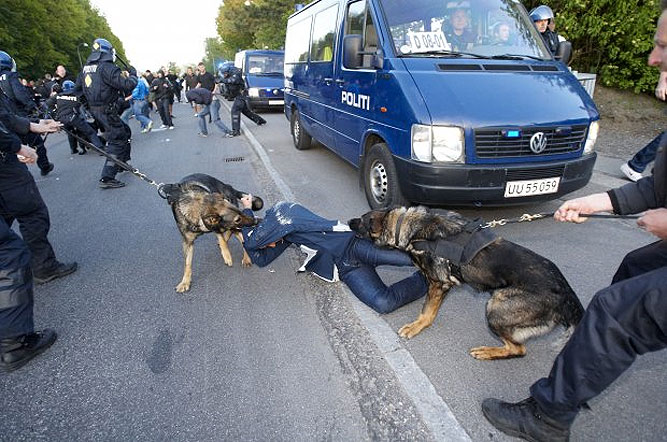 After a soccer game between Skive and FCK in Denmark a bunch of supporters were suddenly attacked by aggressive police dogs after doing nothing. One of the supporters says to the local news that he doesn’t understand why they attacked him and knocked him over, as well as some of his supporter friends. There were children and women nearby that got really shocked by the police dogs behavior. The Copenhagen police encouraged the dogs to attack and bite them, but they say that their dogs went crazy and that they couldn’t stop them. Not very convincing. The police said they were sorry for the incident, but injured supporters think it’s all a lie just to avoid guilt.
From Stop Police Brutality
Denmark bans Marmite
After Denmark banned Redbull, now British Marmite is illegal in Denmark.
 As far as Marmite goes, the Danish government hates the stuff. That at least is the conclusion that many foreigners have drawn following a ban on the sticky brown yeast extract.
The sales ban enforces a law restricting products fortified with added vitamins. Food giant Kellogg's withdrew some brands of breakfast cereal from Denmark when the legislation passed in 2004, but until now Marmite had escaped the attention of Danish authorities.
Marmite is not the only product to have fallen foul: Horlicks, Ovaltine and Farley's Rusks are similarly proscribed.
The ruling is not going down well with the country's substantial expatriate community – many of them work for large multinational firms such as Lego and Vestas, only to move away after a year or two.
The government has admitted it is having trouble retaining these highly skilled foreign workers, and has even debated measures in parliament to make them stay. This latest move is unlikely to help.
Recent comments from the Danish immigration minister, Søren Pind, that foreigners should "assimilate" or leave, coupled with the country's recent unilateral decision to reinstate border checks, have left some residents questioning the motivation behind the crackdown.
Lyndsay Jensen, a Yorkshire-born graphic designer in Copenhagen, despaired of the move.
"They don't like it because it's foreign," she said, adding that she already planned to send off for supplies from abroad. "But if they want to take my Marmite off me they'll have to wrench it from my cold dead hands."
More at Guardian and at The Telegraph (Marmite made illegal in Denmark)
 As far as Marmite goes, the Danish government hates the stuff. That at least is the conclusion that many foreigners have drawn following a ban on the sticky brown yeast extract.
The sales ban enforces a law restricting products fortified with added vitamins. Food giant Kellogg's withdrew some brands of breakfast cereal from Denmark when the legislation passed in 2004, but until now Marmite had escaped the attention of Danish authorities.
Marmite is not the only product to have fallen foul: Horlicks, Ovaltine and Farley's Rusks are similarly proscribed.
The ruling is not going down well with the country's substantial expatriate community – many of them work for large multinational firms such as Lego and Vestas, only to move away after a year or two.
The government has admitted it is having trouble retaining these highly skilled foreign workers, and has even debated measures in parliament to make them stay. This latest move is unlikely to help.
Recent comments from the Danish immigration minister, Søren Pind, that foreigners should "assimilate" or leave, coupled with the country's recent unilateral decision to reinstate border checks, have left some residents questioning the motivation behind the crackdown.
Lyndsay Jensen, a Yorkshire-born graphic designer in Copenhagen, despaired of the move.
"They don't like it because it's foreign," she said, adding that she already planned to send off for supplies from abroad. "But if they want to take my Marmite off me they'll have to wrench it from my cold dead hands."
More at Guardian and at The Telegraph (Marmite made illegal in Denmark)
Subscribe to:
Comments (Atom)