Denmark has stolen children from their foreigner parents

Thursday, August 05, 2010

World's worst foreign minister

Lene Espersen, Denmark’s deputy prime minister, is under pressure to stand down after a string of gaffes led to her being dubbed the world’s worst foreign minister.
Miss Espersen has missed multiple high-level summits since March, including three meetings with Hillary Clinton, the US Secretary of State, and the Kabul Conference on the future of Afghanistan.
She has missed 13 key meetings in recent years and was this week called the “world’s worst” foreign minister by a German newspaper.
Luck appears to have deserted the 44-year-old mother of two. She missed the Kabul summit because her plane was diverted to Kazakhstan after a rocket attack closed Kabul airport. Uzbekistan then closed its airspace to her flight. She claimed she would speak to the Uzbek ambassador to Copenhagen but that role does not exist.
She once failed to attend a meeting of Arctic countries because she was on an Easter break in Majorca. She has previously defended missing meetings by saying it was typical practice in many cases to send another foreign representative in her place.

Source: The Telegraph
Reference: here (in danish with video)

Jailed in Denmark not guilty

Drug charges dropped against woman who sat 23 months in jail
The Crown Prosecutor’s office will pay a Romanian woman 480,000 kroner in compensation after she spent nearly two years in custody for drug charges that were eventually dropped, according to public broadcaster DR.
In January 2008 the 23-year-old woman was arrested at Copenhagen Airport and charged with smuggling 10 kilograms of heroin. She was found guilty of the charges by a city court, but that verdict was overturned when it was found the judge’s previous position as an airport customs official created a conflict of interest.
A Turkish man was eventually convicted for the crime and the Romanian woman was set free in March.
The Crown Prosecutor accepted the compensation figure of 480,000 kroner which was recommended by the Public Prosecutor’s office based on the woman’s initial demand of 1.3 million kroner.

Source: Copenhagen Post

Tax Evasion

The leader of Denmark's main opposition party says she made a "big and sloppy error" by giving incorrect information to the Danish authorities about her husband, Stephen Kinnock.
Social Democrat leader Helle Thorning-Schmidt was speaking after the Danish tabloid newspaper BT had accused her husband of evading Danish taxes.
Mr Kinnock is the son of Lord Kinnock, the former UK Labour Party leader.
He works and pays tax in Switzerland on a reported income of £110,000.
Mrs Thorning-Schmidt admitted making a mistake over the amount of time her husband had spent in Denmark.
They have their family home in the Danish capital Copenhagen, even though Mr Kinnock works in Switzerland.

Mrs Thorning-Schmidt, who has campaigned for higher taxes for high earners, insists that her husband has resided in Denmark for only 33 weekends per year.
Therefore, she argues, he does not have to pay taxes in Denmark.
But when the couple applied for permission for Mr Kinnock to buy half of their shared home, Mrs Thorning-Schmidt wrote to the authorities that her husband spent "every weekend of the year from Friday through to Monday" in Denmark.
As a non-resident and UK citizen Mr Kinnock would not normally be allowed to buy a property in Denmark.

More at BBC

Tuesday, August 03, 2010

Danish plan to cut immigrants' pay

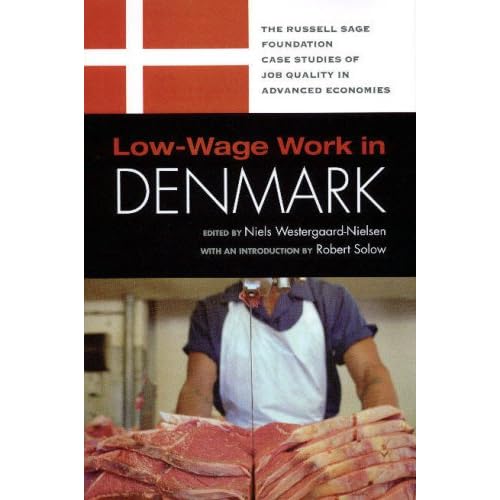
A bitter political row has erupted in Denmark over proposals by a member of the ruling party to slash the minimum wage for immigrant workers by half to help them gain a foothold in the jobs market.
The controversial plan has been put forward by Karsten Lauritzen, the immigration spokesman for Prime Minister Lars Rasmussen's Venstre liberal party, which rules in a coalition with the conservatives.
"Denmark's high minimum wage acts as a barrier which prevents immigrants from getting jobs. If we want to get them out of the ghettos we will have to pay them less," Mr Lauritzen told the Berlingske Tidene newspaper,

Mr Lauritzen has proposed paying immigrant workers around 50 Danish Krone (€6.50) an hour for the first six months, compared to the country's average minimum wage of 100 Krone per hour, arguing that a two-tier wage system would help them into jobs that might then lead to regular employment.
The proposal has been vehemently opposed by Denmark's leftwing parties, but is also causing a ruckus within his own party.
Immigration Minister Birthe Hornbech, a fellow Venstre member, has clashed publicly with Mr Lauritzen, even though he is her department's spokesman. "The idea is disagreeable because it stigmatises immigrants," she said.

Source: The Independent with comments.

Saturday, July 31, 2010

Quickies

It emerged that the city of Copenhagen had requested Danish government assistance to deport up to 400 Roma, and that Swedish police had expelled Roma in breach of its own and EU laws. (From here)

Zero-Energy Housing Wedge in Denmark. Of course, danishes are masters at projects on computer designs about utopic zero energy environments, but from theory to practice is a long way.

Monday, July 19, 2010

Cradle-To-Grave System Gets Rocky in Denmark

In addition to free education and universal health care, the linchpins of the welfare state model, Denmark provides an extensive list of social benefits enjoyed during a lifetime regardless of income. These include government-sponsored child-care checks, student stipends, unemployment benefits, early retirement funds, elder care and a state-funded pension program.
But in recent weeks, in light of the credit crunch and a growing public debt problem, Denmark’s generous public spending has come under scrutiny. Specifically, the state-funded pension program — which costs 96 billion kroner, or $16 billion, annually, an estimated 5.5% of gross domestic product — has fueled a discussion about the paradox of Denmark’s high earners receiving many of the same social benefits as the very neediest citizens.
The comments come as Denmark, long heralded as a model for economic and social stability, scrambles to reduce a public expenditure that last year surpassed 59 percent of G.D.P., clocking in at over 1 trillion kroner, while working to decrease a public-sector debt equal to 42% of G.D.P.
Mr. Bendtsen has suggested that anyone receiving more than 500,000 kroner annually from a private pension should be excluded from the state-funded program. The Danish Insurance Association, an industry group, calculates that there are only 4,000 people who fall into this category, or 1 percent of the 400,000 Danes who have private pensions.
Mr. Bendtsen’s trial balloon has attracted responses from several quarters of Danish society, and the comments have a similar thrust: Something must be done, but not at the expense of the social model.
Denmark has the highest overall tax burden of all O.E.C.D. member countries, with taxes to G.D.P. reaching 48.2% in 2009. Furthermore, numbers from the O.E.C.D. show that Denmark has one of the highest marginal tax rates for high earners — 67% — when consumer taxes are included.

Read more at The New York Times

Thursday, July 15, 2010

Lower Minimum Wage for Immigrants

The debate over integration is shrill in Denmark. The small country repeatedly makes international headlines on the issue. The current coalition government of conservatives and right-wing liberals has already introduced Europe's toughest immigration law. The far-right Danish People's Party constantly agitates against the nation's 450,000 immigrants.
Karsten Lauritzen, integration spokesman for the ruling right-liberal party Venstre, has proposed that immigrants be paid far less than Danes. His idea is that migrants should work for around 50 krone an hour (around €6.50 or $8.40) instead of the current minimum hourly wage of around 100 krone. There is no official legal minimum wage in Denmark, but pay is regulated by a series of wage agreements negotiated by labor unions.
Lauritzen is selling his idea as in the interests of the immigrants: he says that the high wages are preventing "immigrants and new Danes" from getting jobs. If you want to get migrants out of their ghettos and into the labor market then new ideas are required, Lauritzen argues. The politician told the Berlingske Tidende newspaper that he envisages a situation where an immigrant would get just half the minimum wage for the first six months. After all, he argued, some immigrants now take unpaid work to gain a foothold in the labor market. He assured the paper that he had his party's backing on the issue.
Migrants working for a pittance -- the suggestion may seem absurd, but it's shared by many in Danish politics, and it is not as easily dismissed as, say, a recent suggestion in Germany that immigrants be subjected to intelligence tests.

Complete at Der Spiegel

Thursday, July 08, 2010

Quickies

A quick extract from Promoting Indonesia to the Danish (The Jakarta Post)
Like any country, he said there were some people in Denmark who he thought were silly. “They have a way of thinking that everything that’s not Danish is bad, or people of other cultures and ethnic background are there to steal our money, our jobs, our women,” he said with a laugh. “It’s childish and foolish,” he said

Wednesday, July 07, 2010

Foreigners paid to leave Denmark

Immigrants who can’t or won’t integrate into Danish society will get a bonus if they return home
The Danish People’s Party (DF) has strengthened its immigration stance by securing an agreement to pay ‘anti-social’ foreigners 100,000 kroner to leave Denmark.
As part of the on-going budget negotiations, the government’s traditional ally DF said it secured the agreement late last night.
Refugees and those who come to Denmark under family reunification schemes currently get 28,256 in repatriation support if they leave, of which 11,000 is a bonus. The bonus is usually paid out a year after the recipient returns home and their right to Danish residency expires.
The new deal would see 100,000 kroner given as a bonus if a foreigner returns home and gives up their residency rights in Denmark.
Neither the government nor DF has yet elaborated on what constitutes an ‘anti-social’ foreigner, but have said that it would be aimed at those who ‘can’t or won’t integrate’.
According to DF party leader Pia Kjærsgaard, the move will save the state a significant sum in local costs which are administered by local and regional councils.

But opposition parties are shocked by the news saying it sends a clear signal to foreigners that Denmark wants to see them leave the country.

Read the juicy comments at The Copenhagen Post

Saturday, July 03, 2010

Quickies

Denmark's foldable self-locking bike

Nakked running at the Roskilde Festival 2010 (video1 and video2). This is an annual tradition and the winners (1 male and 1 female) get a free ticket for next years festival.